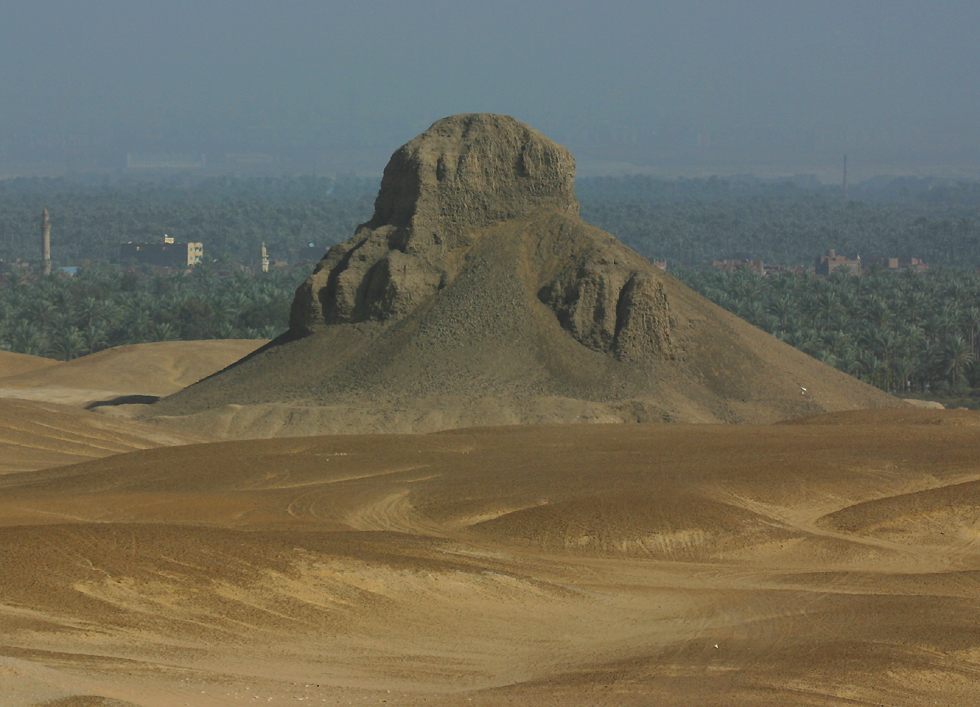
When you first get to Dahshur, you might be forgiven for not paying much attention to the strange looking hill or heap of rubble shown below. In fact, however, this is the so-called Black Pyramid of pharoah Amenemhat III who ruled from 1855-1808 BC during the Middle Kingdom period. Although it might look like a total wreck, the Black Pyramid is one of only three of the original eleven pyramids at Dahshur which are still standing, and the interior passageways and chambers of the Black Pyramid are almost entirely intact.
The background of date palms on the flood plain of the Nile tells part of the reason why this pyramid collapsed - it's only 10 meters above sea level, and built on an unstable foundation of hard clay. Another reason is the building materials used - primarily mud brick and, apart from its outer covering, there was far less stonework in its structure than most other pyramids. It's thought that this was the first pyramid with burial chambers built to house both a pharoah and his queens. The bones of both queen Aat and his second consort, who might have been Neferuptah, were found in their burial chambers - however, despite the presence of a sarcophagus in the king's burial chamber, it seems that he was buried at another pyramid he built, at Hawara. Surprisingly, though, there were four other burials inside the Black Pyramid and archaeologists speculate that two of these might have been pharoah Amenemhat IV and his queen, Sobekneferu.
You can't approach the Black Pyramid because it's in a restricted military zone, so this photo was taken with a long lens from the Bent Pyramid, described later.
|
 |

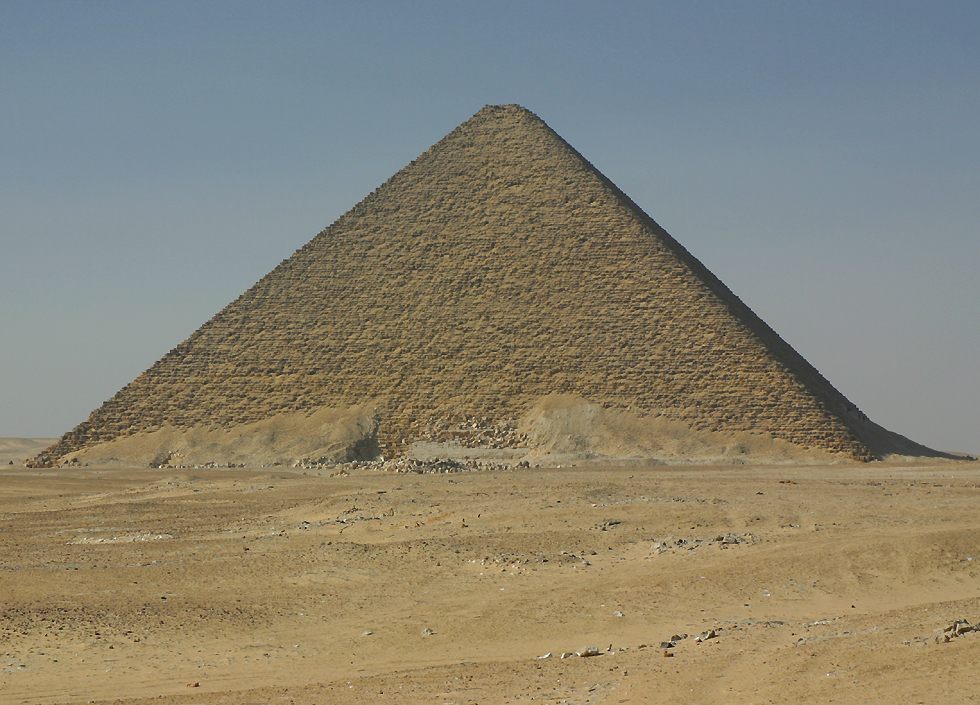
And now look how high that entrance is when you're at ground level! The edge of the pyramid in this photo isn't even as steep as it is in real life, because of the angle from which I took this shot. It's a fairly good haul up to the entrance, let alone to the top of the pyramid!
|
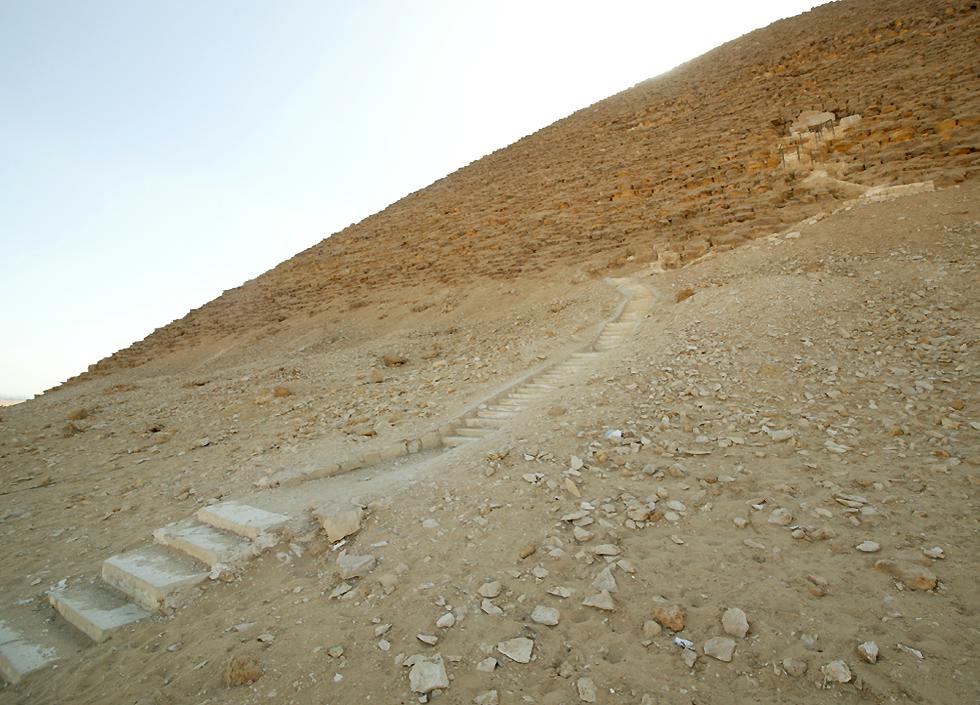 |
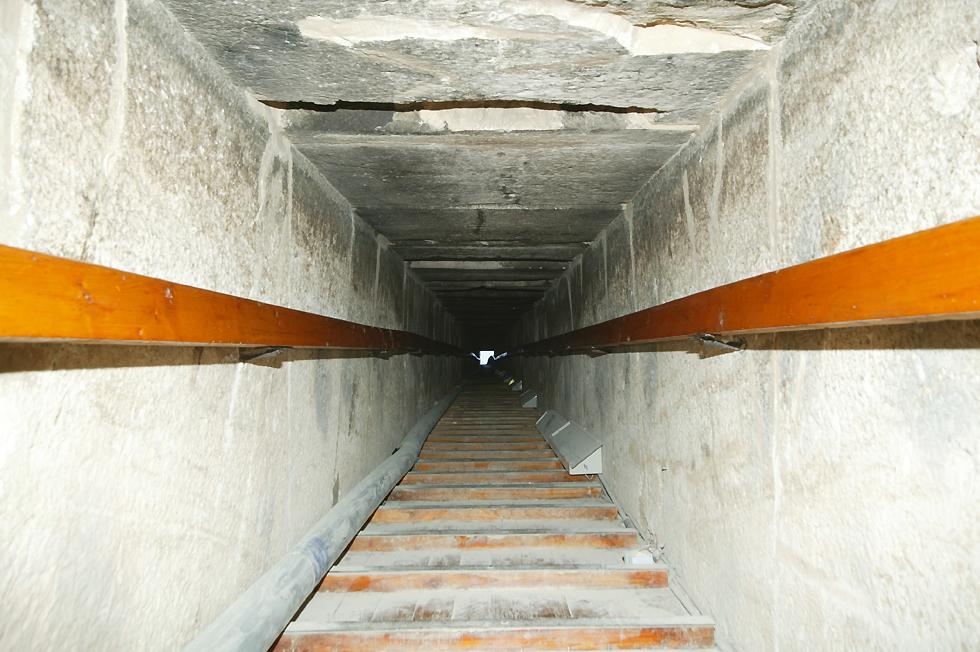
Once at the entrance, it's then a 63 meter long hunched-over walk down this 27 degree ramp into the pyramid. The entrance in this photo would be square, except for the old arab man who was sitting there. Perhaps he was looking after the air pump, whose pipe you can see on the left of the ramp, or perhaps he was "guarding" the pyramid. Nevertheless, when I came out I took this as another Baksheesh Moment, and gave him a little something for his efforts, whatever they were. Despite the pumping of air, it was very hot and sticky inside the pyramid, even on a day which was rather cold and windy outside.
|
 |
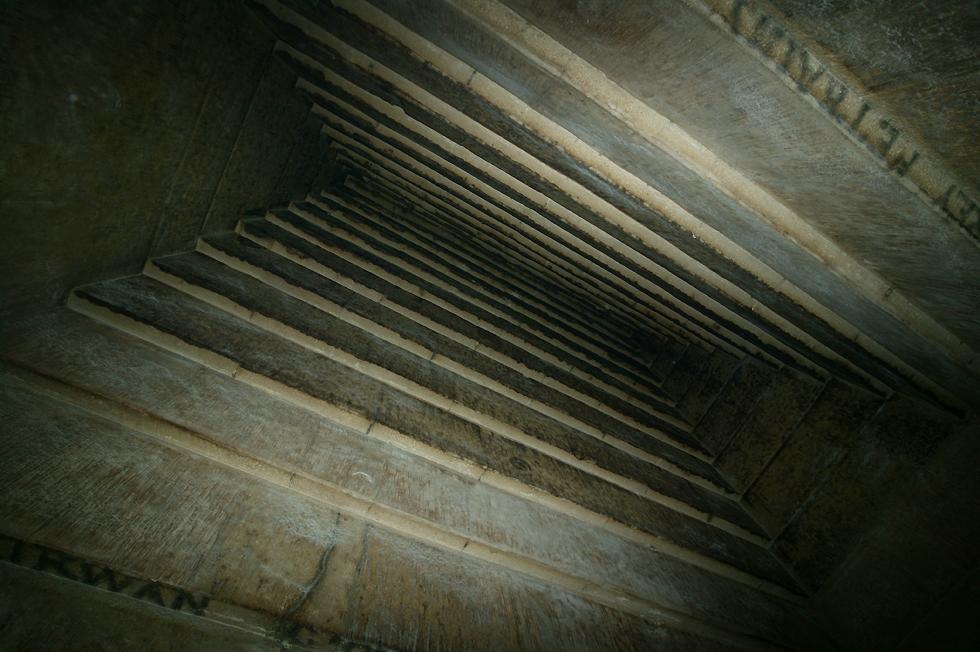
There are three rooms or chambers inside the pyramid, joined by a single corridor. The ancient Egyptians didn't come up with the idea of the arch as a load-bearing mechanism in stone buildings, so when they did construct rooms in stone structures they either used lots of stone pillars spaced close together, as in many of the "hypostyle halls" found in temples, or they used large slabs of stone for the ceiling, or when they wanted a larger room, they built so-called "corbelled" ceilings like this one in the 12 meter high first chamber, with higher and higher levels of stone moving slowly in towards the center, the huge mass of stone above the room keeping the ceiling from falling in on itself. The black writing in two corners of this photo is graffiti left by people who marked their names in the mid-1800s in their own personal strivings towards immortality.
|
 |
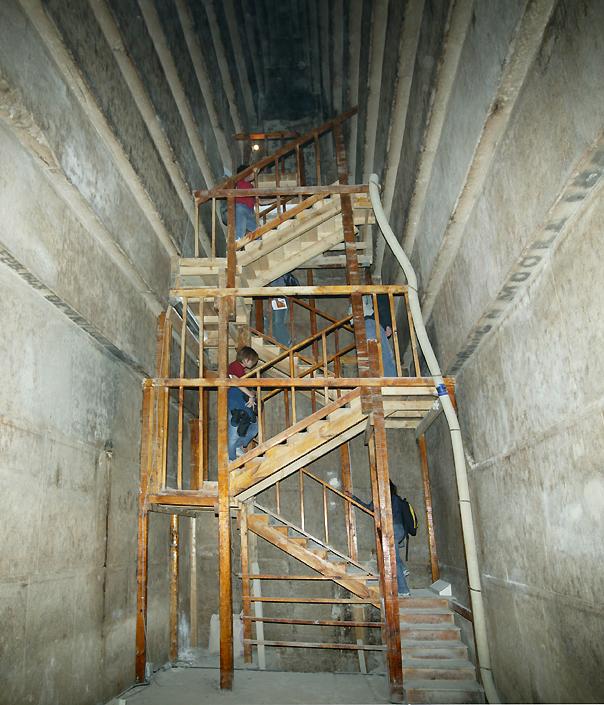
Here's the second corbelled chamber, which is directly beneath the apex of the pyramid. The staircase leads up to a passageway to the final chamber.
Thieves were breaking into burial chambers even from the earliest days, so the passageways inside the pyramids were deliberately made to be difficult to follow, with deep pits for unwary grave robbers to fall into and stone blocks called portcullises which were lowered from the ceiling to block the path. Nevertheless, almost all of them were eventually ransacked.
|  |
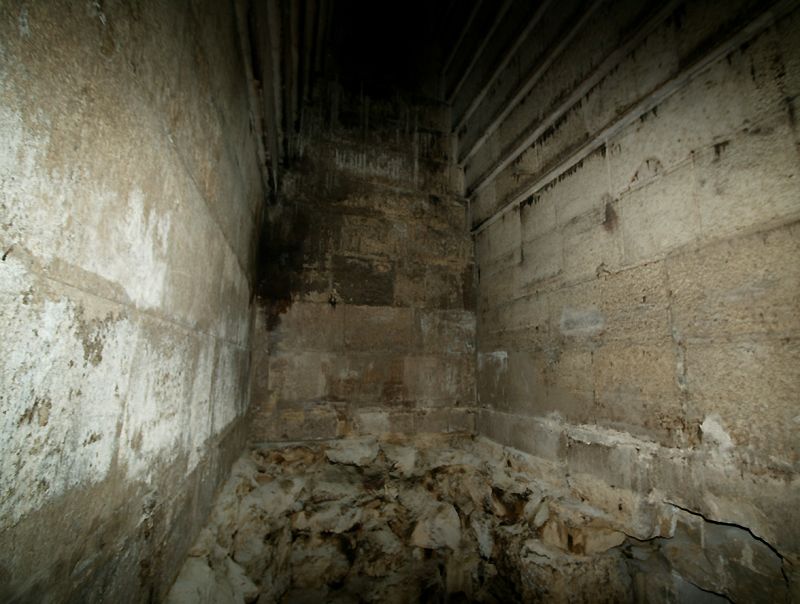
The third corbelled chamber is the burial chamber, which is 15 meters high and lacks ornamentation, unlike the much later highly decorated tombs in the Valley of the Kings and the Valley of the Queens. As you can see from this photo, all of the chamber's contents have been removed and its floor has been excavated, in an unsuccessful attempt to find other passageways.
|
 |
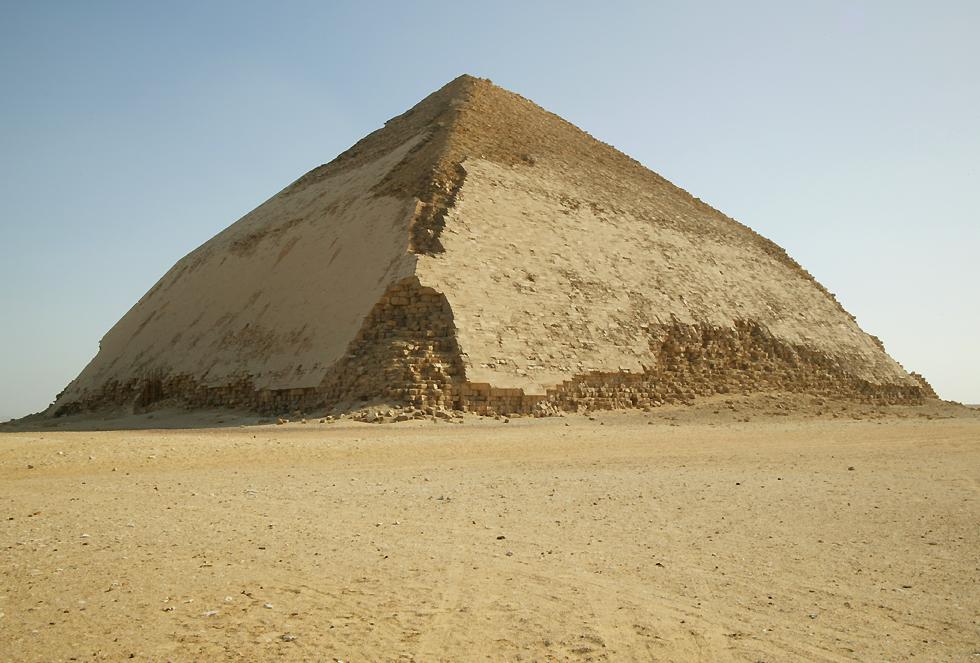
Both the Bent Pyramid and its close neighbour the Red Pyramid were built by the pharoah Sneferu, about 2,600 BC. His son Cheops went on to build the Great Pyramid at Giza. For such an early structure, the Bent Pyramid is massive, the same height as the Red Pyramid, which also makes it the third-highest in all of Egypt. The shape which gives it its name is something of a mystery, the result perhaps of a design error or cost cutting.
|
 |